
What’s the Difference and Why Should You Care?
Your car breaks down, you call a mechanic. Your semi breaks down, you call a diesel mechanic.
Those are not the same person and mixing them up costs real money.
A lot of truck drivers and fleet managers find this out the hard way. They call whoever picks up first, the shop swaps a few parts and the truck still has the same problem two days later. That’s not bad luck. That’s the wrong mechanic for the job.
What a Regular Auto Mechanic Actually Does
Regular auto mechanics work on cars and light trucks, the kind most people drive to the grocery store. Oil changes, brake pads, spark plugs, maybe some electrical work. They’re good at what they do. The problem is what they’re trained on.
A gas engine uses spark plugs to ignite the fuel. The mechanic at your local shop knows that system well. But a diesel engine works completely differently. There are no spark plugs. Diesel fuel ignites from pressure and heat alone. The fuel system runs at pressures that would blow apart a gas engine. The whole thing is built to haul heavy loads for hundreds of thousands of miles, and the repairs reflect that.
Walk a gas engine mechanic up to a Cummins or CAT engine with a derate code and a regen fault and most of them won’t know where to start.
What a Diesel Mechanic Knows That Others Don’t
Diesel mechanics train on the systems that keep commercial trucks, heavy equipment and work vehicles running. Semi-trucks. Excavators. Dozers. Buses. RVs with diesel drivetrains. These vehicles have components that passenger cars don’t even have.
Air brake systems, for one. Your car has hydraulic brakes. Commercial trucks run on air and the system has compressors, valves, lines and air-operated brake chambers that all have to work together. A diesel mechanic knows how to find an air leak and fix it. A regular mechanic usually doesn’t touch that system at all.
Then there’s the emissions side. Modern diesel trucks have diesel particulate filters, DEF systems and EGR components all working to control what comes out of the exhaust. When one of those fails, the truck can go into derate which is a reduced-power mode that keeps it limping along until the problem gets fixed.
Diagnosing that correctly takes engine-specific software and experience with those fault codes. It’s not something you figure out with a basic scan tool from the parts store.
The fuel system is another gap. High-pressure diesel injection systems operate at pressures that require specialized testing equipment just to measure safely. Injectors, lift pumps, injection pumps, each one fails in its own way, and chasing the wrong one burns through money fast.
The Real Cost of Calling the Wrong Person
Here’s what actually happens when a diesel truck goes to a shop that isn’t set up for it. They hook up the scan tool, read a code, replace the part the code points to and send the truck back out. Two days later the same light comes on. The code was a symptom. The real problem is still there.
That’s not the shop being dishonest. It’s just the limit of their training and equipment.
With a commercial truck, that guesswork gets expensive fast. You’re paying for the parts, the labor and every hour the truck sits. A truck that moves freight and earns money sitting in a shop bay or on the side of the road is money gone. Getting the diagnosis right the first time is worth more than saving a few dollars on the initial call.
What Bennett Mobile Truck Repair Handles
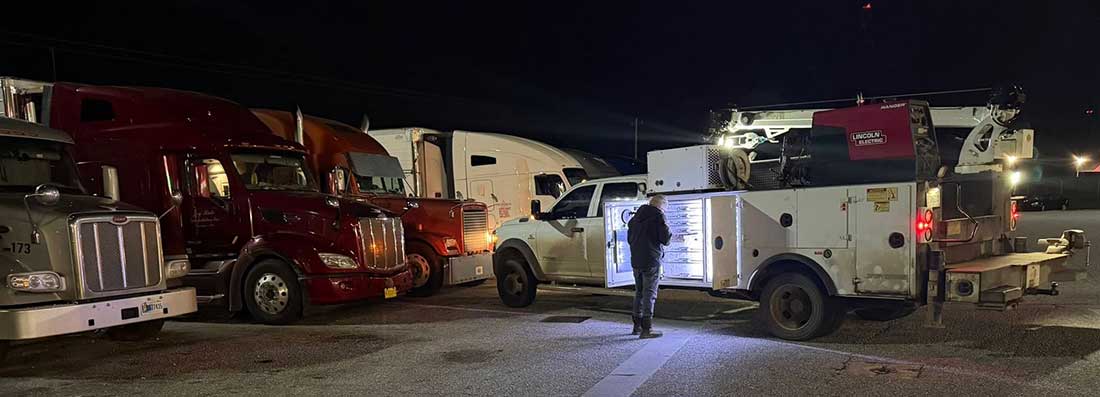
We work on diesel-powered trucks, heavy equipment and RVs. CAT Certified and Cummins Certified. And we come to you, which means no tow bill and no time wasted getting to a shop.
On the truck side, we handle engine diagnostics and repair, no-start and hard-start problems, derate and check engine light diagnosis, fuel system repairs, cooling system issues, electrical problems, air system and brake air repairs, DPF and regen issues and preventative maintenance. If your excavator, loader or dozer is down at the job site, we do that too. Same with RV engine and transmission work.
The goal every time is the same. Figure out what’s actually wrong, explain it clearly and fix it right so you’re not calling again next week for the same thing.
Which One Do You Need?
If your gas powered pickup truck won’t start, a regular mechanic can probably help you. If your diesel work truck or semi is sitting on the shoulder of I-75 with a derate code and low air pressure, that’s a diesel mechanic call. The sooner you get the right person on the phone, the sooner you’re moving again.
Bennett Mobile Truck Repair runs 24/7 and covers a 60-mile radius out of Hahira across South Georgia and North Florida.
Call anytime, really anytime we’re available 24/7: (229) 740-9286
Related Posts
If you enjoyed reading this, then please explore our other articles below: