
The most common wrong belief about 24/7 mobile diesel truck repair is that the “best” option is simply the one that answers the phone fastest. Speed matters, but the real differentiator is whether the technician can diagnose correctly in the field, carry the right parts and tools, and document the repair so the truck returns to service without a repeat failure two days later.
For a dispatcher, fleet manager, or owner-operator, the usable question is more practical: which service is most likely to get the truck back to safe operation the first time, at any hour, on the kind of diesel platform you actually run?
How to choose the best 24/7 mobile diesel truck repair service (the criteria that matter)
The best service is not a single brand or a magic tagline. It is a set of capabilities aligned with how diesel trucks fail on the roadside, and with how your operation keeps time and cost. A truck that sits for 12 hours costs more than the repair invoice, so the “best” service reduces downtime, not just labor hours.
1) Diagnostics that match modern diesel systems
Modern diesel trucks are rarely “fix the obvious thing” machines. A no-start event might involve fuel delivery, air leaks, sensor faults, DEF dosing issues, or a software-related derate condition. A service that relies only on basic mechanical checks will often replace parts guesswork-style, which increases cost and extends downtime.
They need mobile diagnostics that can read manufacturer-specific fault codes and live data, not just generic error numbers. The mechanism is straightforward: diesel failures often produce the same headline symptom (hard start, limp mode, low power), but the fault codes and sensor readings point to different root causes. When the tech has the right scanner, it changes the decision tree from “try this” to “test this, then repair that.”
2) Field capability: the right tools, not just a wrench
Roadside work has constraints. The tech may be in rain or darkness, limited by available power, and required to complete repairs without a full bay. The best providers bring portable tools that support both mechanical and electrical troubleshooting, such as:
- Heavy-duty scan tools with manufacturer coverage and service functions when needed
- Battery testing and charging equipment sized for diesel starting loads
- Air system tools</strong for leak detection and pressure verification
- Fuel system test capability (pressure, flow checks, line inspection)
- Basic fabrication and fastening materials for temporary but safe stabilization when long repairs are deferred
That list matters because many roadside problems escalate when a tech cannot verify the condition before reassembly. For example, replacing a fuel filter without confirming the suction side is air-tight can leave a truck stuck in a no-start loop. The “best” service prevents that loop with verification steps.
3) Parts logistics that reduce “come back tomorrow” repairs
Parts availability is where 24/7 support usually breaks down. A dispatcher can’t wait for a shop shipment scheduled for the next business day. The best 24/7 mobile diesel mechanic either carries common fast-moving parts or have a rapid parts network designed for after-hours response.
Look for a provider that can explain their parts approach clearly. Do they stock filters, batteries, relays, sensors, belts, and common wear components? Do they have identified sourcing partners within a defined radius? Do they set expectations for when they will attempt a same-night fix versus when a safe tow to the nearest facility is the correct choice?
4) Technician qualification and experience with your truck profile
Diesel fleets are not interchangeable. A service that excels on older mechanical engines may struggle on newer emissions architectures. The reverse is also true. The best provider aligns technician experience with the truck models you operate, including year range and emission system generation.
Qualification is not just years in the field. It includes practical diesel diagnostics under roadside constraints, plus familiarity with common failure modes in your usage patterns (regional routes, stop-and-go, cold starts, long idling). The mechanism behind better outcomes is experience translating symptom into the right initial tests. With the right background, the tech avoids wasted cycles.
5) Clear communication, documentation, and warranty terms
In a roadside emergency, communication is the difference between a controlled repair and a chaotic one. The best services provide consistent status updates, a repair plan, and the estimated timeline. They also document what they found, what they replaced, what they tested after the repair, and what the driver should monitor.
Documentation protects everyone. It supports warranty decisions, helps fleet maintenance staff trace recurring faults, and reduces the chance of an unnecessary rework when the truck returns to a shop. Warranty terms are a practical indicator of confidence, but the details matter: what is covered, for how long, and under what conditions.
What “24/7” should mean in practice, not on paper
Some companies advertise 24/7 availability but only for intake. The technician may show up within a wide window, or they may dispatch only for certain problem categories. That mismatch can create long delays during the most costly hours.
Response-time expectations
Instead of chasing a single number, evaluate how a provider sets timelines. The service should ask for location, truck type, symptoms, any fault codes, and whether the vehicle can safely move or must be shut down. Those questions let them triage the job and dispatch the right level of capability.
Mechanically, diesel failures fall into different “risk bands.” A stuck parking brake or flat tire might be lower risk than a fuel leak or overheating event. The best service routes resources accordingly because they understand that safety and damage control affect the final repair cost.
Operating model: dispatch, escalation, and after-hours parts
24/7 service requires a staffed dispatch function, a technician on call, and an escalation path if the first attempt does not complete the repair. Ask whether they can coordinate with tow providers, body shops, or your in-house maintenance team.
In many fleets, the emergency repair becomes part of a larger incident response. A quality service helps by providing an incident-ready repair summary that your internal team can use to close the work order quickly.
Coverage area and service radius
The best provider for one region may not be the best for another. Coverage area affects response time, and it also affects parts replenishment. Before selecting a provider, check the typical operating distances from your lanes and hubs.
A provider may be excellent but limited to a few counties. For a long-haul operation, that limitation can be the real gap, even if the company appears strong online.
Common roadside diesel emergencies and how top services handle them
Searchers for 24/7 mobile diesel truck repair are usually facing a failure right now, so it helps to align expectations with the problem type. The “best” service does not treat every call the same way.
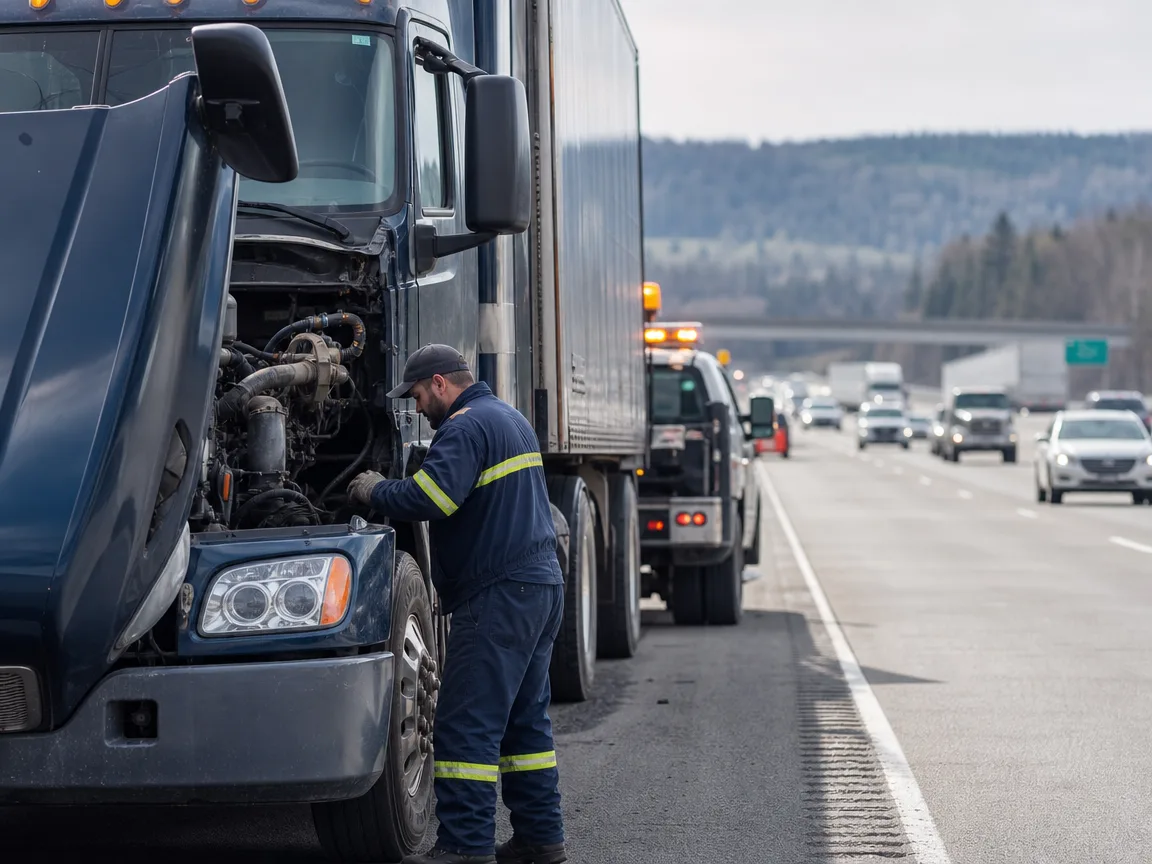
No-start and hard-start conditions
No-start problems often involve batteries, starter circuits, air pressure, fuel delivery, or sensor faults. A strong service begins with voltage and current verification and checks for obvious electrical issues, then moves to fuel pressure and air system validation based on symptoms.
The key mechanism is eliminating false positives. If the tech swaps parts without confirming system conditions, the truck may still not start after “repair,” leading to repeat calls. The best providers test first, then repair, then retest.
Limp mode, low-power events, and derates
Modern diesel trucks can enter limp mode due to emissions system faults, turbo or boost-related problems, DEF quality or dosing issues, or sensor readings that fall outside acceptable thresholds. The fastest way to waste time is to clear codes without addressing the cause.
Technicians with proper diagnostics can interpret fault codes in context, verify whether the condition is present under load, and decide whether the truck can proceed safely or should be towed. That decision affects whether the truck avoids further damage or continues to operate in a way that increases repair scope.
Overheating and coolant or oil leaks
Overheating is a time-sensitive scenario. The best services prioritize damage control, such as verifying coolant level and leak points, inspecting fan operation, checking for restricted flow, and confirming correct operation after repairs. When overheating is severe, the correct outcome might be tow-to-shop rather than roadside completion.
The mechanism here is thermal risk. Continuing to run an overheated diesel can compound damage to head components and gaskets. A service that “always fixes it on the roadside” can cost fleets more than a service that correctly chooses towing when needed.
Air system issues and brake-related problems
Air leaks can come from fittings, lines, or components affected by vibration and road debris. Brake performance and air pressure stability must be verified before releasing a truck back into operation. The best mobile services use pressure testing and leak localization rather than replacing parts blindly.
For fleets, the value is not only the immediate repair, but also the reduction of repeat failures. A confirmed leak repair with post-repair checks reduces the chance of another roadside call during the same trip.
A practical comparison: what to ask providers before they arrive
People searching for 24/7 mobile diesel truck repair are often busy and under pressure. Still, a few high-value questions can separate a capable roadside operation from one that will waste time.
Questions that reveal real capability
- Which diagnostic tools do you carry, and do you have manufacturer coverage for my truck year and model?
- What parts do you typically stock for common roadside failures like fuel filters, batteries, sensors, belts, relays?
- How do you test after the repair to confirm the fault condition is resolved?
- What is your warranty on mobile repairs, and how is it documented for fleet maintenance?
- Do you dispatch with the right technician level for electrical, emissions, or heavy mechanical issues?
- If the truck cannot be safely repaired on scene, what is your tow coordination approach?
These questions work because they force the provider to describe their process. A strong operation will explain their diagnostic workflow, parts strategy, and verification steps, not just availability.
A quick scoring rubric
Even without formal procurement, a scoring rubric helps decisions under time pressure. Rate each provider on a 1 to 5 basis for the following:
- Verification discipline (do they test before and after repair)
- Parts readiness (stock and sourcing speed)
- Diesel experience fit (your truck types and emission systems)
- Documentation and warranty clarity
- Clear dispatch process (triage, timelines, escalation)
The top scorer is the best candidate. The bottom scorer is the one to avoid, especially when the truck is carrying sensitive loads, is near schedule windows, or needs to pass safety compliance soon.
Service models: what “mobile repair” can look like
Not all mobile repair services deliver the same outcome. Some excel at completing most repairs on scene. Others focus on triage and tow coordination. Both can be valid, but the reader should match the model to their risk tolerance and route planning. When calling, make sure the mobile mechanic you call is a diesel mechanic, not just a mobile mechanic who works on gas powered vehicles.
On-scene repair emphasis
This model aims to stabilize and repair enough to restart or continue. It works best when common parts are available and damage is limited. The trade-off is that some complex issues may still require tow or follow-up repairs at a shop.
The mechanism behind success is that diagnostics and parts logistics align. When the tech arrives with correct scan coverage and likely parts, roadside repair completion rates rise.
Triage plus tow coordination
This model prioritizes safety and prevents additional damage. The truck may be repaired minimally enough to avoid catastrophic failure, then towed for definitive work. In overheating or severe emissions faults, this approach often prevents larger, more expensive follow-on repairs.
For fleets with strong shop partners, triage-and-tow can reduce total downtime because it avoids a half-repair that later fails under load.
Hybrid approach
The best providers often do both. They attempt on-scene repair when conditions allow, and they switch to tow when diagnostics indicate higher risk. The “best” is the consistent decision-making that protects the driver and reduces repeat failures.
Pricing and authorization: how to avoid billing surprises
Cost control is part of choosing the best 24/7 mobile diesel truck repair service. Roadside emergency pricing can be higher than shop rates because of after-hours labor, travel distance, and specialized equipment. Still, a quality provider explains charges clearly.
What affects the price
- Distance to scene and expected travel time
- Diagnostic time before parts replacement
- After-hours labor premium depending on the time window
- Parts availability, including expedited delivery costs
- Complexity such as emissions-system troubleshooting
The mechanism that prevents surprises is authorization clarity. The provider should confirm authorization for diagnostic time, parts ordering, and any additional work beyond the initial scope.
Fleet-friendly billing practices
Fleet managers typically want itemized invoices, clear part descriptions, labor breakdowns, and warranty terms. Some providers can send documentation in a format that maintenance teams can quickly close in their work order system.
If the service cannot provide adequate documentation, the fleet loses time on follow-up internal review, which often erases any initial cost advantage.
Safety and compliance considerations during roadside repair
Diesel truck roadside repair is not only a mechanical problem. It involves risk management: traffic safety, hazard control, emissions handling, and safe reactivation. The best service approaches roadside work with structured safety checks.
Traffic and scene safety
Technicians need safe access to the vehicle and must follow appropriate traffic management practices. A capable provider will ask where the truck is located, whether hazards are properly set, and whether the driver is in a safe position.
Mechanically, scene safety also affects the quality of the repair. Working in an unsafe environment can lead to rushed work, missed torque specs, or incomplete checks.
Emissions and DEF-related care
If the truck enters limp mode due to emissions faults, technicians should follow manufacturer guidance for diagnostics and repairs. DEF contamination issues, incorrect fluid, or sensor errors require careful handling. Clearing codes without addressing the underlying issue can lead to repeated derates and the possibility that the vehicle will fail an inspection later.
How to prepare now so the emergency response is faster
Even with the best vendor, response time starts with preparedness. Fleets that plan reduce downtime even when the call is unexpected.
Create a “mobile repair readiness” checklist
- Keep truck identifying data accessible (VIN, engine model, emission system details)
- Record recent maintenance (filters changed, sensor replacements, recent work orders)
- Train drivers on symptom reporting (when the fault started, dash alerts, whether the truck can move safely)
- Maintain basic supplies for common roadside conditions (wheel chocks, gloves, clean rags, absorbent for leaks)
- Have your authorization process defined so dispatch does not stall the repair
This preparation works because it reduces diagnostic time. The technician can focus on likely causes sooner, verify the right systems, and avoid a broad sweep that costs billable minutes.
Pre-vet a provider for your most common lanes
If the fleet has predictable routes, it can pre-vet the provider’s coverage and likely arrival windows for those lanes. Pre-vetting also helps align your service expectations: when to request tow, what parts to stock in your operation, and how to handle recurring fault codes.
The outcome is simple: fewer decisions during crisis hours, more decisions before the crisis.
Table: choosing the best mobile repair model for different emergency types
The “best” choice depends on which failures are most likely on your routes and how your operation handles downtime. 1 through 3 below helps match emergency type to a practical provider model.
1) Emergency Type
- Battery failure or basic electrical no-start
- Fuel delivery or filter-related no-start
- Limp mode with unclear cause
- Overheating or major coolant/oil leak risk
- Air system leak or brake pressure instability
- Repeat faults after prior work
2) Best-Fit Service Model
- On-scene repair emphasis
- On-scene repair emphasis, if parts stock is strong
- Hybrid approach
- Triage plus tow coordination
- Triage plus tow coordination or hybrid
- Triage plus strong diagnostics
3) Why It Works
- Fast diagnostics and common parts enable restart
- Test-and-repair reduces repeat failures
- Full code interpretation guides repair vs. tow
- Prevents compounding damage from continued operation
- Verification after repair protects safety and compliance
- Investigation identifies the root cause, not just the symptoms
So, what is the best mobile diesel truck repair service for 24/7 roadside emergencies?
The reader looking for a single “best” answer usually wants an action. Since no universal winner exists across every region and truck profile, the most accurate recommendation is to select the service that consistently demonstrates three outcomes during real roadside scenarios: correct diagnostics, verification after repair, and parts logistics that match your diesel platform.
What to look for on day one (a practical shortlist)
When comparing providers, the strongest candidates typically have these traits:
- Proven diesel diagnostic capability with manufacturer coverage and live data reading
- Documented repair workflow, including “test before” and “test after” records
- Reliable parts strategy that either stocks common failures or sources quickly after hours
- Clear warranty terms and straightforward authorization communication
- Regionally realistic response coverage for the lanes you actually drive
These criteria work because they directly address the two biggest failure modes of roadside repairs: replacing the wrong thing due to weak diagnostics, and leaving an issue unresolved due to missing verification steps.
A field-tested “first-call” mindset
For most fleets, the best provider is the one that reduces repeat calls. A repeat call is expensive not only in direct service fees, but also in driver time, scheduling disruptions, and load risk. Top-tier services prevent repeat calls by confirming the system is truly back within spec, not merely clearing a code.
That mindset also affects how the technician handles uncertainty. When the service cannot safely complete the repair, it should say so early and coordinate towing to prevent a larger failure later.
Final decision: the trade-off the reader is really choosing between
Choosing the best 24/7 mobile diesel truck repair service is ultimately a trade-off between speed-first triage and completion-first diagnostics. A speed-first approach can get the truck moving sooner for minor problems, but it can also increase the odds of repeat failures when the root cause is unclear. A completion-first diagnostic approach takes a bit longer at the start, but it prevents the cycle of guessing and rework.
For the common case, where fleets want maximum uptime across varied roadside failures, the plain recommendation is to select a provider that prioritizes diagnose with verification and then repair, while also offering a safe tow plan when roadside completion is not appropriate. When a provider can explain that process clearly and align it to your diesel platforms, it becomes the best fit for true 24/7 roadside emergencies.
Related Posts
If you enjoyed reading this, then please explore our other articles below:

